

VisibleThread has earned its place in a lot of GovCon proposal shops. It reads a solicitation faster than a person can, pulls requirements into a compliance matrix, flags FAR and DFARS flow-downs, and tells you when your prose has drifted into passive voice and 40-word sentences. If that is the problem you have, it is a good tool and this guide will not try to talk you out of it. The reason teams start searching for a VisibleThread alternative is usually scope, not quality: the tool sits in the middle of the proposal workflow but does not reach either end. It will not find the opportunity, and it will not produce the finished volume. This guide covers eight alternatives, what each one is genuinely built to do, and how to decide which - if any - you actually need.
What Are the Best VisibleThread Alternatives?
The right VisibleThread alternative depends on which job you are replacing. For federal teams that want one platform covering sourcing, solicitation analysis, drafting, gate reviews and compliance, Proposal Connect is the closest end-to-end replacement. For high-volume commercial RFx work, Loopio and Responsive are the established choices. For market intelligence rather than proposal production, Deltek GovWin IQ answers a different question altogether.
Closest end-to-end swap
Proposal Connect
Federal workflow from SAM.gov import through compliance tracking to exported volume, in one system.
Commercial RFx volume
Loopio & Responsive
Answer libraries and response workflows built for question volume rather than federal structure.
A different problem
Deltek GovWin IQ
Market and opportunity intelligence. It informs the bid decision; it does not write the proposal.
VisibleThread Alternatives by Category
Buyers reach VisibleThread through five different category labels, and the strongest alternative changes depending on which one brought you here. If you arrived searching one of these terms, start with the matching recommendation.

VisibleThread Alternatives for GovCon RFP Software
Start with Proposal Connect. This is the federal-specific category. Evaluating VisibleThread as GovCon RFP software, you get Section L and M shredding and FAR flow-down identification, but not SAM.gov sourcing, set-aside logic or the production of the response itself.
 L
 R
VisibleThread Alternatives for RFP Software
Start with Loopio or Responsive. The general, mostly commercial category. As RFP software, VisibleThread analyzes documents you already have rather than assembling responses, so an answer library and question assignment are what you are actually missing.
 G


AI for Proposals: VisibleThread Alternatives
Start with GovDash, Rohirrim or pWin.ai. Evaluating VisibleThread on AI for proposals, its models grade and score writing more than they generate it, and reviewers call the bid-writing side weak for a full RFP response. These AI-native entrants target the drafting job instead.

VisibleThread Alternatives for Proposal Management Software
Start with Proposal Connect or Unanet. As proposal management software, VisibleThread covers part of the job with a Kanban board, bid/no-bid support and amendment tracking. It does not cover gate reviews, section ownership or version-controlled collaborative drafting.
GLVisibleThread Alternatives for Proposal Automation
It depends which half you mean. For proposal automation, VisibleThread automates the review half - compliance checks, readability scoring, document comparison - but not the production half of solicitation import, drafting, volume assembly and export. If you want both halves in one place that is the end-to-end category above; if you only wanted review automated, you may already have the right tool.
Key Takeaways
- 1 VisibleThread is an analysis layer, not a production platform. Compare it against what you need it to replace, not against a generic feature list.
- 2 Consolidation is the usual motive. Most teams are not unhappy with VisibleThread - they are tired of moving documents between two or three tools by hand.
- 3 Commercial RFP tools are not federal tools. Loopio and Responsive are excellent at question volume and weak on Section L/M structure, set-aside logic, and FAR flow-downs.
The bottom line: decide whether you want a better analysis tool or fewer tools. That single question eliminates most of this list.
What VisibleThread Actually Does
A fair comparison starts with an accurate baseline. Based on VisibleThread's own product documentation and verified reviews on Capterra, this is the shape of the product:
Where it is strong
- Requirement shredding from Word and PDF into a compliance matrix
- FAR and DFARS flow-down identification
- Readability and grade-level scoring, passive voice and long sentence flagging
- Acronym, jargon and tone-of-voice consistency checks
- Microsoft Word add-in and SharePoint integration
Where teams hit its edges
- No opportunity sourcing from SAM.gov or GovWin IQ
- AI bid writing exists, but reviewers describe it as weak for producing a full RFP response
- No Shipley gate reviews or structured color team workflow
- No version-controlled collaborative drafting
- Reviewers note compliance matrix output can need manual cleanup
It does include a proposal management Kanban board, bid/no-bid decision support, and amendment tracking - so it is not purely an analyzer. The gap is production: nothing in the product turns an analyzed solicitation into a finished, exportable proposal.
How We Compared These Alternatives
We deliberately avoided a feature-checkbox table. Vendor feature sets in this category change every quarter, and a checkmark grid built from marketing pages ages badly and misleads buyers. Instead each alternative is described by the job it is built to do, which is far more stable and more useful when you are shortlisting.
Verify before you buy. Pricing and feature coverage for every vendor here changes frequently, and several are early-stage companies shipping quickly. Treat this guide as a shortlist, then confirm current capabilities and pricing directly with each vendor before making a decision.
Eight VisibleThread Alternatives
Grouped by what they replace, not by rank. The first group covers the full federal proposal workflow, the second is AI-native GovCon software, the third is commercial RFx, and the last solves a different problem entirely.
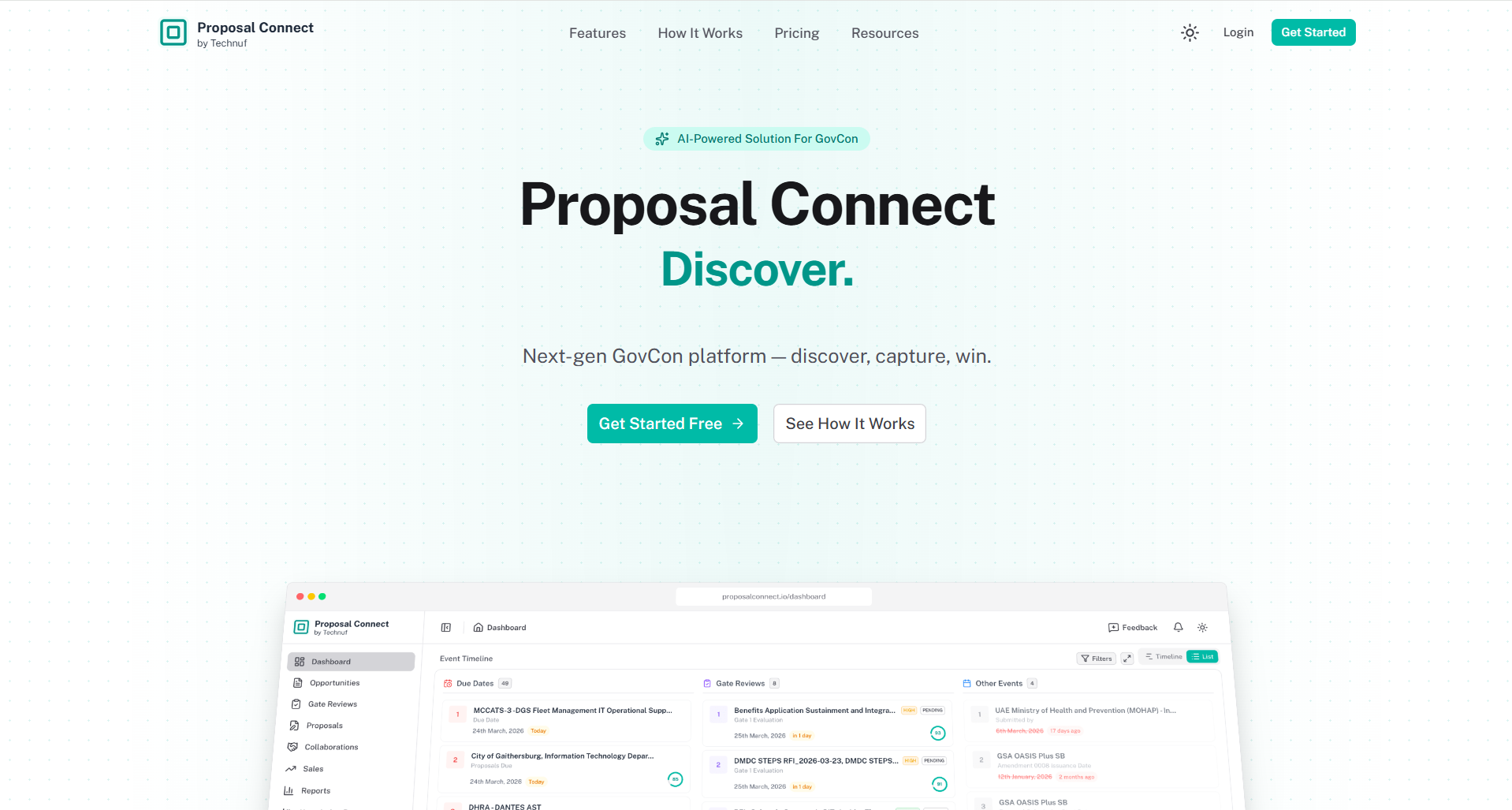
Built specifically for the federal proposal lifecycle rather than for document analysis alone. It imports opportunities from SAM.gov and GovWin IQ, analyzes solicitations section by section, scores GO/NO-GO, runs Shipley gate reviews, tracks compliance requirements against each proposal section, and drafts content grounded in your knowledge base and past performance.
Versus VisibleThread: it covers the compliance-tracking job and adds the two ends VisibleThread leaves open - finding the opportunity and producing the finished volume. Pricing starts at $499 per month. See the full head-to-head comparison for a feature-level breakdown.
An AI-first platform aimed at the federal capture and proposal workflow, positioned around automated drafting and solicitation analysis rather than document quality scoring.
Versus VisibleThread: a production tool rather than a review tool, so it addresses the drafting gap but is a weaker substitute if readability analysis is what you valued. We cover it in detail in our GovDash comparison.

Best known as GovCon ERP and project accounting, with CRM and proposal capabilities alongside. The appeal is consolidation across finance, projects and business development rather than depth in proposal analysis.
Versus VisibleThread: a much broader system solving a much broader problem. Worth evaluating if your proposal tooling decision is really part of a back-office consolidation; overkill if it is not.

An AI-native entrant focused on generating federal proposal content from an organization's own body of prior work, rather than on analyzing documents after they are written.
Versus VisibleThread: effectively the inverse product. It targets the drafting problem VisibleThread does not solve, and does not replace VisibleThread's compliance and readability reporting.
An AI proposal platform built around Shipley-embedded workflows for federal teams. In April 2026 it acquired the customer portfolio of Vultron.ai, which selected pWin.ai as the destination for its users - so if you were evaluating Vultron, this is where that product line now points.
Versus VisibleThread: a production-side alternative rather than an analysis tool. As with any fast-moving entrant, confirm current capability against your own solicitations rather than relying on category positioning.
A mature RFP response platform built around a curated answer library, question assignment, and review workflows. Strong where the same questions recur across many responses.
Versus VisibleThread: solves response assembly rather than document analysis, and carries no federal-specific structure - no Section L/M shredding, no FAR flow-down logic, no set-aside handling. A good fit only if your RFx volume is mostly commercial.
The enterprise end of the commercial RFx market, with deep integrations and governance features for large teams handling high question volume across many concurrent responses.
Versus VisibleThread: same caveat as Loopio. Excellent at scale in commercial procurement, not built around federal compliance structure.

The established source of federal market and opportunity intelligence - pre-RFP tracking, agency forecasts, competitor and incumbent research.
Versus VisibleThread: not a replacement in any direction. It informs which bids to pursue; VisibleThread checks the document you write afterwards. Teams frequently run both, which is exactly the consolidation problem this guide is about.
Which Alternative Fits Your Situation
Start from the reason you are looking, not from the vendor list.
| Why you are looking | Where to start | What to check first |
|---|---|---|
| We want one federal system instead of three tools | Proposal Connect | That its compliance matrix output matches what your reviewers expect today |
| We mainly need faster first drafts | GovDash, Rohirrim, pWin.ai | Draft quality on one of your own past solicitations, not a vendor demo |
| Most of our RFx volume is commercial | Loopio, Responsive | How much federal-specific work you would still do by hand |
| Proposal tooling is part of a wider systems decision | Unanet | Whether proposal depth survives the breadth of an ERP rollout |
| We are bidding the wrong opportunities | Deltek GovWin IQ | That your problem is pipeline, not production - they need different tools |
When You Should Keep VisibleThread
A buyer's guide that never recommends staying put is a sales page. Three cases where switching is the wrong move:
- Readability compliance is a contractual or policy requirement. If plain-language scoring is something you must demonstrate, that is VisibleThread's core competence and few alternatives match its depth there.
- Your proposal production already works. If your team is productive in Word and SharePoint and the only thing you wanted was analysis, adding a platform adds change management you do not need.
- You are a subcontractor reviewing, not producing. Teams that mostly review prime-authored volumes need exactly what VisibleThread does and little of what the alternatives add.
Frequently Asked Questions
What are the best VisibleThread alternatives for government contractors?
It depends which job you are replacing. For one platform covering sourcing, analysis, drafting, gate reviews and compliance, Proposal Connect is the closest end-to-end swap. For commercial RFx volume, Loopio and Responsive. For market intelligence, Deltek GovWin IQ. GovDash, Rohirrim and pWin.ai are AI-native GovCon entrants worth shortlisting.
Is VisibleThread proposal automation software?
Partly. It automates proposal review - compliance checks, readability scoring, terminology consistency, document comparison. It does not automate proposal production - solicitation import, drafting, volume assembly, export.
Is VisibleThread a proposal management platform?
Partly. It includes a Kanban board, bid/no-bid decision support, and amendment tracking. It does not include Shipley gate reviews, a structured color team workflow, or version-controlled collaborative drafting.
Why do government contractors look for a VisibleThread alternative?
Usually scope rather than quality. The tool sits in the middle of the workflow but does not source opportunities or produce the finished proposal, which leaves teams stitching two or three tools together by hand.
Can I use VisibleThread alongside another proposal platform?
Yes, and many teams do - it integrates with Word through an add-in and with SharePoint. The question is whether you need two subscriptions, or whether one platform with built-in compliance tracking covers enough of the same ground.
What should I check before switching from VisibleThread?
List the outputs your team actually relies on, confirm the alternative produces an equivalent rather than something adjacent, check it covers what VisibleThread does not, and verify current pricing and features directly with each vendor.
See the Whole Workflow in One Place
Bring one of your own solicitations. Import it, watch the analysis and compliance matrix build, and judge the draft against work your team has already produced.