

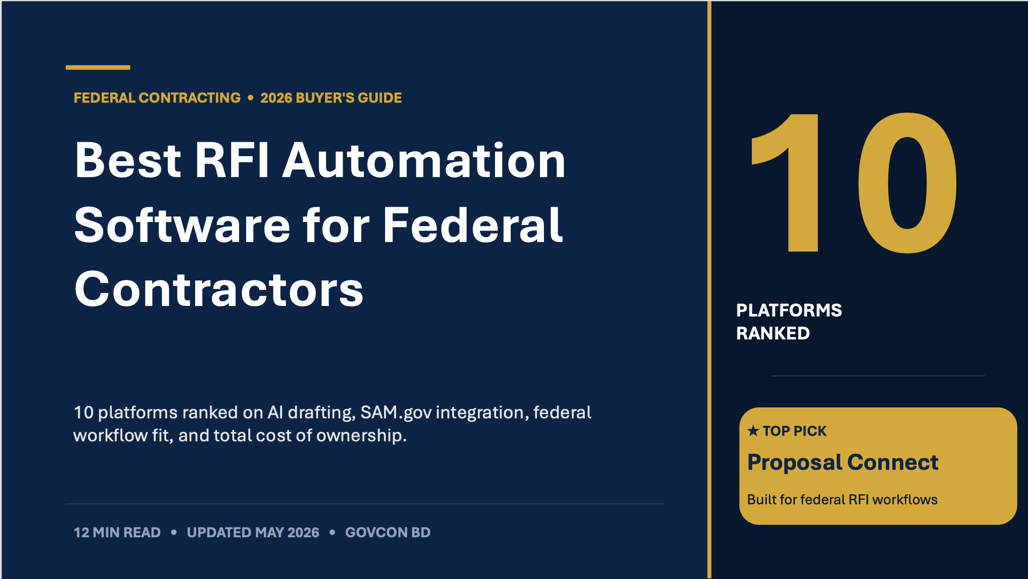
Best RFI Automation Software — 2026
The 10 platforms that actually automate Request for Information responses for federal contractors — ranked by AI capability, federal workflow fit, knowledge base depth, and total cost of ownership.
Most federal contractors treat RFIs and sources sought notices as second-class work — written under deadline pressure by whoever has bandwidth, formatted in Word at 11pm the night before they're due. That's a strategic mistake. RFI responses are how the eventual RFP gets shaped: set-aside decisions, NAICS code selection, page limits, evaluation criteria — agencies use the RFI feedback loop to scope the procurement. Contractors who respond to 30+ relevant RFIs per year consistently win more awards than contractors who only show up at RFP time. The problem is volume: at 8-16 hours per RFI in a manual workflow, that's hundreds of BD hours that don't directly produce a contract. The right RFI automation software changes the math entirely. This guide ranks the 10 best platforms for federal RFI automation in 2026, with our top pick being Proposal Connect — the only platform purpose-built for federal RFI and sources sought workflows.
Key Takeaways
- 1 Proposal Connect is the strongest RFI automation choice for federal contractors. It is the only platform that combines AI drafting, capability statement integration, SAM.gov auto-import, and federal-specific compliance in one workspace at an SMB price point.
- 2 Commercial RFI tools like Loopio, Responsive, and RFP360 are powerful for high-volume commercial RFx work but lack federal-specific structure — set-aside attestations, FAR clauses, capability statement formatting, NAICS qualification logic.
- 3 RFI volume drives RFP win rate. Contractors who respond to 30+ RFIs per year shape the requirements they later compete on. Automation is what makes that volume actually possible without growing the BD team.
The bottom line: RFI automation isn't about saving a few hours per response — it's about responding to 3x more RFIs and influencing the procurement before competition opens.
How We Evaluated These Tools
We evaluated each tool through the lens of a small-to-mid federal contractor — typically 10-500 employees, responding to a mix of RFIs, sources sought, and full RFPs. Our review draws from product documentation, verified user reviews on G2 and Capterra, and hands-on testing where available.
Does the AI draft RFI responses grounded in real past performance, or does it invent generic boilerplate?
SAM.gov import, set-aside attestations, FAR clauses, NAICS qualification, capability statement integration.
Does it ingest your past proposals, capability statement, and past performance citations as living source material?
From import to export-ready document — how fast can a typical sources sought response actually ship?
Real-time editing, SME review workflows, capture-to-submission handoff without email chaos.
Full annual cost including seats, AI usage, integrations, and required add-ons — not just sticker price.
The 10 Best RFI Automation Software for 2026
Ranked by federal RFI workflow fit, AI drafting quality, and value for small-to-mid contractors.
Proposal Connect
Top PickBest end-to-end federal RFI automation
Proposal Connect is purpose-built for federal contracting. The RFI workflow imports the SAM.gov sources sought notice in three clicks, drafts the four standard response sections (company overview, relevant experience, capability response, NAICS and set-aside qualification) using AI grounded in your knowledge base, and exports to a fully formatted DOCX matching the agency's instructions. Capability statement, past performance citations, UEI, CAGE code, and NAICS qualifications all auto-populate from a single source of truth. A typical sources sought response takes 30-60 minutes from import to submission-ready PDF.
Strengths
- 3-click SAM.gov RFI/sources sought import
- AI drafting grounded in your real past performance
- Auto-populated capability statement and UEI
- Set-aside, NAICS, FAR clause logic built in
- Real-time collaborative SME review
- One-click DOCX/PDF export to agency template
Best for
- Federal contractors responding to 20+ RFIs/year
- Small businesses scaling capture without headcount
- Mid-size primes shaping pre-RFP requirements
- Capture consultants serving multiple GovCon clients
Loopio
Best for high-volume commercial RFI response libraries
Loopio is one of the most established RFx response platforms, with a strong content library, AI auto-suggest, and Q&A automation. It is excellent for SaaS and commercial enterprises responding to security questionnaires and commercial RFIs at high volume. The federal RFI fit is weaker — no SAM.gov integration, no capability statement framework, no built-in set-aside logic. Pricing typically starts around $20K/year for a small team and climbs steeply with seats and content library size.
Pricing: Custom, typically $20K-$60K/year
Responsive (formerly RFPIO)
Best for enterprise commercial RFx response at scale
Responsive is the market leader for enterprise RFP/RFI response in commercial markets. Strong AI assist, deep integrations with Salesforce and Slack, robust Q&A library management. For federal RFIs the limitations are similar to Loopio — designed for commercial questionnaires, not federal sources sought. Best fit for organizations that handle commercial and federal RFIs in a single workflow and have the budget for the enterprise tier.
Pricing: Custom, typically $7K-$28K/year
RFP360
Best for two-sided RFI workflows (issue and respond)
RFP360 supports both issuing and responding to RFIs/RFPs, which is unusual in this category. Strong workflow management, content library, and analytics. Federal-specific functionality is limited — no SAM.gov integration, no set-aside attestations. Better suited for organizations that both issue RFIs to vendors (procurement side) and respond to incoming RFIs (sales side).
Pricing: Custom, typically $15K-$50K/year
Qvidian (Upland Software)
Best for legacy enterprise proposal teams
Qvidian is a long-established proposal automation platform with a deep content library and structured response workflows. It can handle RFI responses but the experience is heavier and slower than newer AI-native tools. Pricing reflects the enterprise positioning. For teams already on Qvidian for RFPs, RFI response is supported but not the primary use case.
Pricing: Custom, typically $10K-$30K+/year
VisibleThread
Best for RFI/RFP shred and compliance analysis
VisibleThread is the leading shred-and-analyze tool for federal solicitations. It extracts requirements from RFI/RFP documents and produces compliance matrices. It does not draft responses — you still write in Word — so it solves the analysis side of RFI work but not the drafting side. Often used alongside a separate drafting tool. Strong fit if your bottleneck is requirement extraction, not writing.
Pricing: Custom, typically $5K-$20K/year per module
Expedience Software
Best for Word-native RFI response workflows
Expedience operates as a Microsoft Word add-in, so RFI response work happens directly in Word. Content library, AI assist, and Shipley-aligned templates are available inside the Word ribbon. Strong fit for teams that refuse to leave Word; weaker fit for teams that want a modern web-based workspace with real-time collaboration.
Pricing: Per-seat licensing, custom
GovWin IQ (Deltek)
Best for finding RFIs in the first place
GovWin IQ is not a response tool — it is a market intelligence platform that helps you find relevant RFIs and sources sought before they hit SAM.gov. Pair it with Proposal Connect (or another response tool) for the full pipeline-to-submission workflow. Indispensable for proactive capture; useless for actually drafting the response.
Pricing: $13K-$50K+/year by tier
Proposify
Best for sales proposals — not federal RFIs
Proposify is a sales proposal platform, not really an RFI tool. Beautiful templates, e-signature, and pipeline tracking — great for commercial sales documents. The federal RFI fit is essentially non-existent: no SAM.gov import, no Section L/M structure, no FAR clauses. Included here only because it sometimes appears in the same searches.
Pricing: $19-$65 per user/month
PandaDoc
Best for document workflow — not RFI response
PandaDoc is a document automation and e-signature platform. Like Proposify, it can be forced into an RFI response use case but is not built for it. No federal-specific structure, no AI drafting grounded in past performance, no SAM.gov integration. Better suited for commercial contracts and sales documents than federal RFIs.
Pricing: $19-$59 per user/month
Side-by-Side: RFI Automation Capability
How the top platforms compare on the features that matter most for federal RFI response.
| Feature | Proposal Connect | Loopio | Responsive | RFP360 | Qvidian |
|---|---|---|---|---|---|
| SAM.gov RFI auto-import | Native, 3 clicks | No | No | No | No |
| AI drafting grounded in past performance | Yes | Q&A library only | Q&A library only | Q&A library only | Limited |
| Capability statement integration | Yes | No | No | No | No |
| Set-aside / NAICS qualification logic | Yes | No | No | No | No |
| Real-time collaborative editing | Yes | Yes | Yes | Yes | Limited |
| DOCX export to agency template | One-click | Generic export | Generic export | Generic export | Yes |
| Typical time per RFI response | 30-60 min | 2-4 hours | 2-4 hours | 3-5 hours | 4-6 hours |
| Starting price | $299/month | $20K/year | $7K/year | $15K/year | $10K/year |
Pricing reflects published or commonly reported rates as of June 2026. Vendor-quoted pricing varies by seats, content library size, and add-on modules. Time-per-response estimates reflect typical federal sources sought (5-15 page response).
The Automated RFI Response Workflow
Here is exactly how an automated RFI response gets shipped on Proposal Connect.
Import the RFI from SAM.gov
Paste the SAM.gov notice ID. The platform pulls the full sources sought package — body, attachments, response instructions, agency POC — into a new RFI workspace in 90 seconds.
AI extracts the agency questions
Every numbered question, every requested capability statement element, every NAICS qualification — extracted into a structured response checklist.
Auto-populate company data
UEI, CAGE code, DUNS, NAICS qualifications, SAM.gov registration data, set-aside status — all pulled from your single source of truth and dropped into the response.
Draft each response section with grounded AI
The AI drafts the company overview, relevant experience, and capability response sections by pulling from your past performance citations, capability statement, and approved boilerplate. No invented contracts, no hallucinated credentials.
SME spot-check and final voice pass
A subject matter expert reviews the technical sections in real-time collaborative edit. Inline comments, approvals, and revisions in 15-30 minutes.
Compliance check against the agency checklist
Every numbered question confirmed answered, every required attestation present, page limit verified. No 11pm panic.
Export and submit
One-click export to a fully formatted DOCX or PDF that matches the agency's instructions — fonts, margins, headers, page numbers. Submit through email or the agency portal.
Why RFI Volume Is the Hidden Lever in GovCon Win Rate
Most contractors underinvest in RFI response — and lose RFPs they should have won as a result.
RFIs shape the eventual RFP
Set-aside decisions, NAICS selection, page limits, and evaluation factors are often informed by RFI responses. Strong RFI input means the eventual solicitation is scoped to favor your capabilities.
RFIs build agency familiarity
By the time an RFP drops, the contracting officer has already seen your name. Familiarity reduces evaluator skepticism and improves your perceived credibility.
RFIs surface hidden requirements
The questions agencies ask in RFIs reveal what they actually care about — often more clearly than the eventual RFP. Your capture team learns the customer's real priorities.
RFIs are how teaming partners find you
Primes scanning RFI responses identify potential subcontractors and small business teaming partners. Skipping RFIs means missing teaming invitations.
RFIs validate set-aside eligibility
Sources sought is how agencies prove there are enough qualified small businesses to justify a set-aside. If small businesses do not respond, the procurement opens to full-and-open competition.
RFIs are the easiest "no" to recover from
An RFI response that does not lead to a teaming invitation costs you 30-60 minutes. An RFP loss costs weeks. The volume math overwhelmingly favors RFI participation.

Proposal Connect
Best RFI Automation Software for Federal Contractors — 2026
The only AI-native platform that automates federal RFI and sources sought response end-to-end. SAM.gov import, knowledge-base-grounded AI drafting, capability statement integration, set-aside qualification logic, and one-click export to agency-formatted DOCX. Designed so a small contractor can respond to 30+ RFIs per year without growing the BD team.
Frequently Asked Questions
What is RFI automation software?
A platform that automates Request for Information and sources sought responses — AI drafting, knowledge base, automated formatting, and compliance checking. The best tools cut a typical federal RFI from 8-16 hours of manual writing to 30-60 minutes of guided AI drafting plus SME review.
How is an RFI different from an RFP?
An RFI is pre-solicitation — agencies use it to research the market and shape the eventual RFP. No contract is awarded. RFIs are shorter (5-15 pages), have shorter response windows (1-2 weeks), and have no formal evaluation criteria. They are how you influence requirements before competition opens.
Why should contractors automate RFI responses?
RFIs are high-volume, low-margin work. Manual RFI writing consumes 240-1,600 BD hours per year for an active contractor. Automation collapses that to a fraction of the time, freeing capture to focus on the bids that fund the year while still positioning you for upcoming RFPs.
What is the best RFI response software for federal contractors?
Proposal Connect — purpose-built for federal RFI workflows with SAM.gov import, knowledge-base-grounded AI drafting, capability statement integration, set-aside logic, and one-click DOCX export. Other tools are strong for commercial RFI volume but lack federal-specific structure.
How long does it take to respond to an RFI with automation?
30-60 minutes from import to export-ready PDF on Proposal Connect. SME review adds 15-30 minutes. Total under 90 minutes for a complete, compliant federal sources sought response. Manual workflows on the same RFI take 8-16 hours.
Can AI write a good RFI response?
Yes — when grounded in your knowledge base. Generic AI cannot. Proposal Connect's AI pulls from your capability statement, past performance citations, and SAM.gov registration data to draft responses that are factually accurate and tailored. Reviewers cannot tell the difference except the AI version usually has better compliance coverage.
How much does RFI automation software cost?
Proposal Connect starts at $299/month. Commercial alternatives like Loopio ($20K-$60K/year), Responsive ($7K-$28K/year), and RFP360 ($15K-$50K/year) cost dramatically more and lack federal-specific RFI workflows. For 30+ RFIs per year, Proposal Connect saves 200-400 BD hours annually.
Do RFI responses really influence the eventual RFP?
Yes — significantly. Contracting officers use RFI responses to validate set-aside decisions, refine requirements, set page limits, and identify likely incumbents. Skipping RFIs means competing on requirements someone else helped write.
Respond to 3x More Federal RFIs — Without Growing Your Team.
Bring your next SAM.gov sources sought into Proposal Connect and watch the full automated workflow in action — import, draft, review, export — in under 90 minutes per response.
Disclosure: This article is published by Proposal Connect LLC. Pricing and feature comparisons reflect publicly available product documentation, verified user reviews on G2 and Capterra, and Proposal Connect production data through Q1 2026. Vendor pricing is custom-quoted in many cases; figures shown are commonly reported ranges. Time-per-response estimates reflect typical federal sources sought of 5-15 page response length. Individual results vary by team size, prior workflow, and RFI complexity.