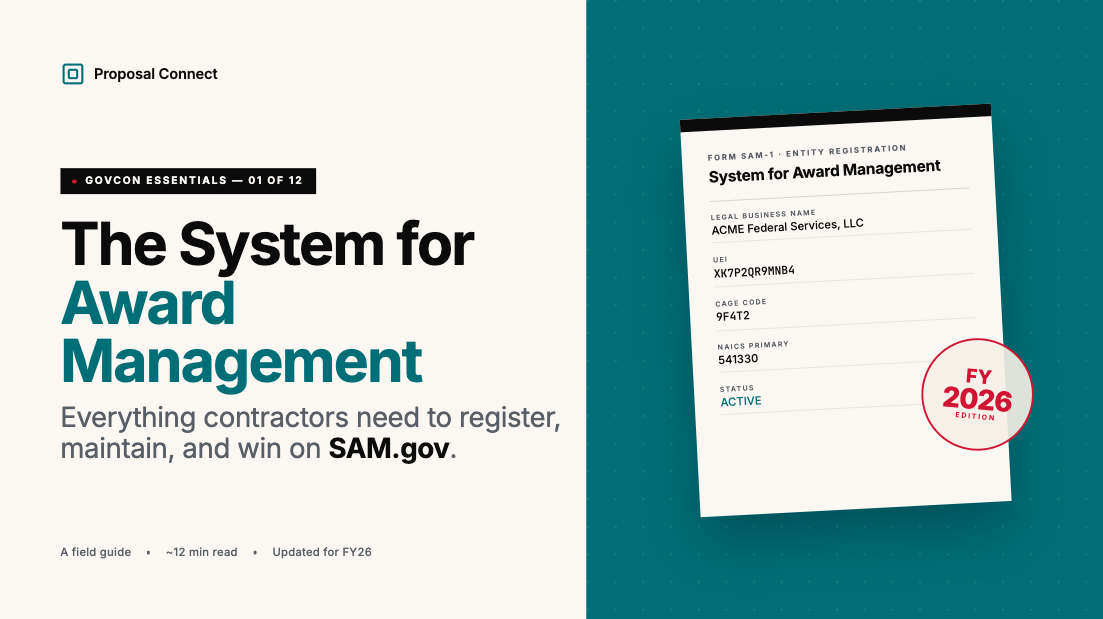
Every government contractor's federal journey starts with the same three letters: SAM. The System for Award Management at sam.gov is the federal government's authoritative entity registration system, the home of the Unique Entity ID, the public feed of contract opportunities, and the data layer that almost every other GovCon tool depends on. If you are new to federal contracting, understanding SAM.gov is non-negotiable. If you are experienced, knowing how to use SAM data programmatically is what separates the teams that scale from the teams that grind. This 2026 guide covers what SAM.gov is, what it does, what you need to do as a contractor, and how modern tools like Proposal Connect turn SAM data into a competitive advantage.
Key Takeaways
- 1 SAM.gov is the single federal entity registration system. No active registration, no prime contract.
- 2 The UEI replaced the DUNS number in 2022. Every SAM.gov entity has a 12-character UEI assigned by the government.
- 3 The SAM.gov data services API lets tools like Proposal Connect import opportunities, validate entities, and run vendor research at scale.
The bottom line: SAM.gov is the operating system of federal contracting. Treat it like infrastructure, not paperwork.
What Is SAM.gov?
SAM.gov - the System for Award Management - is the consolidated federal portal that replaced and absorbed several older systems including CCR, FBO, EPLS, ORCA, and the Wage Determinations OnLine site. As of 2026, it is the single canonical home for the following functions:
Entity Registration
Every business, nonprofit, government entity, or foreign vendor that wants to receive federal funds registers here.
Unique Entity ID (UEI)
The 12-character federal entity identifier assigned by the government, replacing the DUNS number system.
Contract Opportunities
Public posting and search for federal solicitations - the modern replacement for FedBizOpps (FBO).
Federal Hierarchy
Authoritative listing of federal departments, agencies, and offices used across procurement systems.
Exclusions (Debarments)
Public list of entities and individuals barred from receiving federal contracts or assistance.
Wage Determinations
Service Contract Act and Davis-Bacon Act wage rates published and searchable via SAM.gov.
Assistance Listings
Federal grants and assistance programs (formerly the CFDA - Catalog of Federal Domestic Assistance).
Data Services API
REST APIs that expose SAM.gov data to software clients for opportunity sync, entity lookup, and validation.
Why SAM.gov Matters to GovCon
SAM.gov sits underneath every other federal acquisition system. Three concrete reasons it shapes everything you do as a contractor:
- Registration is the gate to doing business. Federal contracting officers cannot legally award you a prime contract or grant if your SAM.gov registration is inactive. Lapses kill awards.
- Your record is read by every system. Your UEI, NAICS, certifications, and POCs flow into FPDS, USAspending, GSA eBuy, GovWin IQ, and downstream contractor tools. Errors propagate everywhere.
- It is your public face. Buying offices look you up in SAM.gov when evaluating capability and certifications. If your entity record is thin or stale, capture is harder than it needs to be.
SAM.gov Registration: What You Need
Initial registration is free, takes 7-10 business days end to end, and requires you to gather a small set of business artifacts in advance. Going in unprepared is the most common reason registrations stall.
Legal Business Name & Address
Must match your IRS records exactly. Mismatches trigger validation failures and delay UEI assignment.
EIN / TIN
Federal Employer Identification Number used to validate your entity with the IRS during registration.
CAGE / NCAGE Code
Assigned automatically by DLA during registration (NCAGE for non-US entities). Required for DoD work.
Banking Information
ABA routing and account number for electronic funds transfer of federal payments.
NAICS Codes
Primary plus all secondary NAICS your business performs. Drives small business size determination.
Reps & Certs
FAR and DFARS representations and certifications. Completed during registration and reaffirmed annually.
POCs
Government business POC, electronic business POC, and past performance POC. Each must be a real person.
Notarized Letter (if required)
Required when you change the SAM.gov account administrator. Submit to the Federal Service Desk.
UEI: The 12-Character Federal Identifier
The Unique Entity Identifier replaced the DUNS number on April 4, 2022. Some artifacts in older internal systems still reference DUNS - replace them with the UEI to avoid downstream issues.
- UEI is 12 alphanumeric characters, assigned by SAM.gov.
- UEI is free. There is no cost to obtain or maintain it.
- UEI is assigned during entity validation, before your full SAM.gov registration is active.
- You can request a UEI without doing a full registration if you only need to be a subrecipient or comply with a reporting requirement.
- Your UEI follows your entity for life. Update legal name or address as needed; the UEI does not change.
NAICS Codes and Set-Asides
Two of the most important fields on your SAM.gov record. Together they determine what opportunities you can compete for and on what terms.
NAICS
North American Industry Classification System codes describe what your business does. Each NAICS has an SBA-defined small business size standard. Your primary NAICS is your main line of work; secondary NAICS expand the opportunities you can pursue.
PSC
Product Service Codes are how the federal government classifies what is being bought. Filtering opportunities by PSC is often more precise than filtering by NAICS for service contracts.
Small Business Set-Asides
Total small business and partial small business set-asides reserve opportunities for SBA-size-eligible firms. Your NAICS-by-NAICS small business status is determined by employee count or revenue thresholds.
Socio-Economic Programs
8(a) Business Development, HUBZone, WOSB, EDWOSB, SDVOSB, VOSB. Each has separate certification requirements and unlocks dedicated set-aside opportunities.
Keep your NAICS list current. The most common SAM.gov error is leaving out NAICS your business actually performs - which silently filters you out of opportunity searches you should be in.
Finding Federal Opportunities on SAM.gov
The Contract Opportunities section at sam.gov/opp/ is where federal solicitations are posted. Notice types you will see:
| Notice Type | What It Means |
|---|---|
| Sources Sought | Market research. The agency is testing whether qualified vendors exist before issuing an RFP. |
| Special Notice | General announcement (industry day, draft RFP, request for information of a special kind). |
| Presolicitation | A formal heads-up that an RFP is coming. Typically includes scope and target release date. |
| Combined Synopsis / Solicitation | Common for simplified acquisitions. The synopsis and the solicitation are issued together. |
| Solicitation | The actual RFP, RFQ, IFB, or BAA. This is the main event. |
| Award Notice | Announces the contract awardee, value, and basic award details. |
| Justification | Justification for an other-than-full-and-open competition (typically a sole source). |
| Cancellation | The opportunity has been withdrawn. Worth tracking - it often returns later in modified form. |
SAM.gov Data Services: The API Layer
For teams that pursue more than a handful of opportunities a month, manual SAM.gov searches do not scale. The SAM.gov data services API is the official way to query the same data programmatically. Free API keys are issued to registered SAM.gov users.
What you can do with the API:
- Pull opportunity notices filtered by NAICS, PSC, set-aside, agency, posted date, and response deadline.
- Look up entity records by UEI, CAGE, or legal business name to validate a vendor or partner.
- Download attachments linked to a solicitation programmatically into your own systems.
- Query the federal hierarchy for canonical agency, sub-agency, and office information.
- Check exclusions before teaming or subcontracting with any vendor.
How Proposal Connect Uses SAM.gov
The same data that powers manual SAM.gov searches is the foundation of automated capture in Proposal Connect. With a one-time API key configured in Settings, the platform turns SAM data into operational workflows:
Opportunity Import
Browse SAM.gov opportunities filtered by your NAICS and certifications, and import in three clicks. Solicitation, attachments, and POCs land in your pipeline ready for AI analysis.
Entity Validation
Vendors added to the CRM are auto-resolved against SAM.gov - UEI, CAGE, certifications, and registration status are pulled in.
Vendor Analyzer
SAM data combines with USAspending awards and subaward records to produce full vendor reports for incumbent research and teaming decisions.
Federal Hierarchy Sync
Agency, sub-agency, and contracting office data is normalized so reporting and pipeline filters stay accurate.
SAM.gov Best Practices for 2026
A short list of habits that separate teams that get the most out of SAM.gov from teams that fight it:
- 1 Calendar the renewal. Annual renewals are mandatory. Set a reminder 60 days before expiration so a missed renewal never costs you an award.
- 2 Audit your NAICS list quarterly. Add new NAICS as your capabilities expand. Each missing NAICS is invisible business you cannot see.
- 3 Keep POCs current. Stale contracting POCs make agencies skip you. Replace anyone who has left the company.
- 4 Use the API, not the UI, for scale. Past 10-20 opportunities a month, the manual UI is a tax. Get the API key and use a tool that consumes it.
- 5 Cross-check your record annually. Spot-check your SAM.gov record against your CRM, capability statement, and pricing schedules. Drift between them costs you bids.
Frequently Asked Questions
What is SAM.gov?
SAM.gov is the System for Award Management - the official US federal site where entities register to do business with the government, get a UEI, and search federal opportunity notices.
Is SAM.gov registration free?
Yes. The federal government does not charge for registration, UEI assignment, or renewals. Third-party services that charge to register on your behalf are optional and often unnecessary.
What is the difference between SAM.gov and the SAM.gov data services API?
SAM.gov is the public website. The data services API exposes the same data programmatically. Tools like Proposal Connect use the API to import opportunities and validate entities at scale.
How long does registration take?
Initial registration typically takes 7-10 business days end to end. Annual renewals usually process in 1-3 days if your data has not changed materially.
What is a UEI and do I still need a DUNS number?
The UEI replaced the DUNS number on April 4, 2022. Every SAM.gov entity has a 12-character UEI assigned by the federal government. DUNS numbers are no longer used in federal procurement.
How do I find federal opportunities on SAM.gov?
Use the Contract Opportunities search at sam.gov/opp/. Filter by NAICS, set-aside type, agency, posted date, and response deadline. For higher-volume teams use the data services API or a tool that imports opportunities automatically.
What set-aside types are tracked in SAM.gov?
All federal small business set-asides: 8(a), HUBZone, WOSB, EDWOSB, SDVOSB, VOSB, total small business, and partial small business. Your record should reflect every certification you hold.
How does Proposal Connect use SAM.gov data?
It imports opportunities into the capture pipeline, pulls entity registration data into the CRM, validates vendors for teaming and incumbent research, and feeds solicitation files into AI analysis and gate-review workflows.
Put SAM.gov Data to Work
Connect your SAM.gov API key to Proposal Connect and turn the federal opportunity feed into a live capture pipeline - with AI analysis, compliance matrices, and vendor intel built on the same SAM data.
Disclosure: This article is published by Proposal Connect LLC. SAM.gov is operated by the US General Services Administration (GSA). Information here reflects publicly documented behavior of SAM.gov and its data services API as of May 2026; check sam.gov for any program-specific updates.