

TL;DR
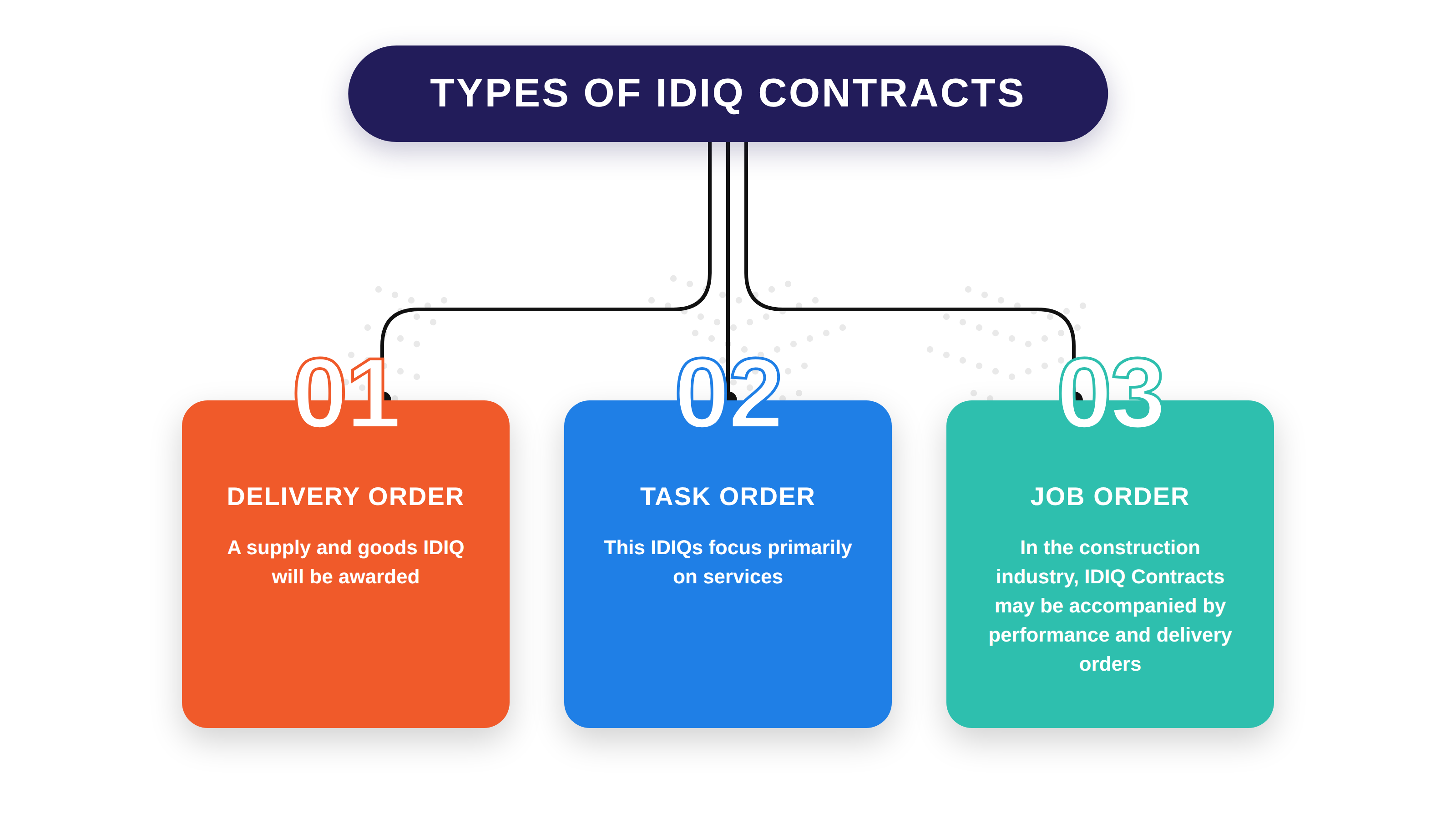
An IDIQ (Indefinite Delivery, Indefinite Quantity) contract is a federal contract that lets an agency buy an unspecified quantity of supplies or services from one or more pre-qualified contractors during a fixed ordering period. Instead of competing every requirement from scratch, the agency awards the umbrella IDIQ once, then issues task orders (for services) or delivery orders (for supplies) against it as needs come up.
For contractors, winning a seat on an IDIQ doesn't guarantee revenue — it gives you the right to compete for task orders during the contract's ordering period, which is usually five to ten years.
Authority: IDIQ contracts are governed by FAR Subpart 16.5 — Indefinite-Delivery Contracts, primarily FAR 16.504. Task order competition rules live in FAR 16.505.
What IDIQ Stands For
| Letter | Meaning | What it really means |
|---|---|---|
| I | Indefinite | The exact timing of orders is not specified upfront |
| D | Delivery | Refers to delivery of supplies, services, or both |
| I | Indefinite | The exact quantity is not specified upfront |
| Q | Quantity | The agency commits only to a guaranteed minimum |
The whole point of the vehicle is flexibility. Federal buyers often know they'll need something — IT services, engineering support, medical supplies, training — but they don't know exactly when, how much, or in what configuration. IDIQs let them lock in pricing, terms, and a vetted contractor pool without having to predict the future.
How an IDIQ Actually Works
Think of an IDIQ as a two-stage procurement:
Stage 1 — The Base IDIQ Award
The agency runs a competition (often a multi-year capture cycle) to pick contractors who meet technical, past performance, and pricing criteria. Winners are awarded a base IDIQ contract that establishes:
- Scope — the universe of work that can be ordered (often defined by NAICS codes, labor categories, or product lines)
- Period of performance — typically a 5-year base with multiple option years (5+5 is common, 10 years total)
- Ceiling value — the maximum total dollar value across all task orders
- Guaranteed minimum — the smallest amount the government legally commits to ordering (often very small — sometimes just $2,500)
- Pricing structure — labor rates, unit prices, or a pricing model the agency uses to evaluate task orders
Importantly, the base award itself is usually worth almost nothing. The real money is in the task orders.
Stage 2 — Task Orders and Delivery Orders
Once the IDIQ is in place, the agency issues individual orders against it whenever a need pops up. Each task order has its own:
- Statement of work (SOW), performance work statement (PWS), or statement of objectives (SOO)
- Period of performance
- Funding
- Deliverables and acceptance criteria
- Often, a mini-competition among IDIQ holders
Under FAR 16.505 (Fair Opportunity), the contracting officer must give every IDIQ holder a fair chance to compete for each task order over the simplified acquisition threshold — with limited exceptions (urgency, sole capability, logical follow-on, minimum guarantee, statutory requirement).
Single-Award vs Multi-Award IDIQ
This distinction matters more than most contractors realize.
| Single-Award (SATOC) | Multi-Award (MATOC) | |
|---|---|---|
| Structure | One prime contractor wins the IDIQ | Multiple primes are awarded a "seat" or "pool" position |
| Task order competition | None — all work goes to the single awardee | Fair opportunity competition among holders for each TO |
| Win probability per task order | ~100% if the work falls in scope | Varies — could be 1-in-3, 1-in-30, or worse |
| Capture cost | High upfront, low per task order | High upfront, plus repeated TO bid costs |
| Common in | Sole-source, niche capabilities, small business set-asides | Large multi-billion-dollar IT and services vehicles |
| Statutory preference | Limited use — FAR 16.504(c) generally favors multi-award | Default for orders > simplified acquisition threshold |
Bottom line for capture teams: Don't just track "did we win the IDIQ?" — track task order win rate and revenue per IDIQ seat. A multi-award IDIQ with 30 holders is a very different opportunity than a single-award.
Common IDIQs Every GovCon Should Know
IDIQ is a contract type, not a specific contract. Most large federal vehicles you've heard of are structured as IDIQs. A few examples:
Government-Wide Acquisition Contracts (GWACs) — IT-focused
- GSA Alliant 2 / Alliant 3 — IT solutions across agencies
- NIH CIO-SP3 / CIO-SP4 — health and IT services
- NASA SEWP V / VI — IT products and product-based services
- GSA 8(a) STARS III — small disadvantaged business IT
- GSA Polaris — small business GWAC for IT
Multi-Agency Services IDIQs
- GSA OASIS / OASIS+ — professional services across all agencies
- GSA ASTRO — robotics, AI, autonomy, and unmanned systems
- GSA HCaTS / HCaTS SB — human capital and training services
Agency-Specific IDIQs
- Army RS3, EAGLE, ITES-3S, ITES-4H
- Air Force NETCENTS-2
- DHS EAGLE Next Gen
- VA T4NG
- State Department EVoLVE
Vehicles That Are NOT IDIQs (often confused)
- GSA Multiple Award Schedule (MAS) — technically a Federal Supply Schedule under FAR Subpart 8.4, similar in feel but operates under different ordering rules
- Blanket Purchase Agreement (BPA) — an agreement, not a contract; ordering vehicle established against a Schedule or open-market
Why Agencies Use IDIQs
For contracting officers, IDIQs solve real procurement pain:
- Speed — Once the IDIQ is in place, individual task orders can be issued in days instead of the 6-18 months a full open-market procurement takes.
- Lower transaction cost — Reusing the base contract terms eliminates redundant negotiation.
- Pre-vetted pool — Past performance, financial responsibility, and compliance reviews are done once, upfront.
- Flexibility on quantity and timing — Agencies don't have to commit to specific quantities until needs materialize.
- Built-in competition — Multi-award IDIQs preserve competition without restarting the whole acquisition.
- Strategic sourcing — Bundling demand drives volume pricing across the federal enterprise.
For these reasons, IDIQ-style vehicles account for a large and growing share of federal spend, especially in IT and professional services.
Pros and Cons for Contractors
Pros
- Long-term revenue runway — A 10-year IDIQ seat positions you as a preferred provider for that scope.
- Faster sales cycle on task orders — Agencies are pre-disposed to use vehicles already in place.
- Competitive moat — The capture cost is high, which limits new entrants once the IDIQ is awarded.
- Past performance generation — Even small task orders generate ratings that strengthen future bids.
- Set-aside protection — Many IDIQs reserve seats or task orders for small business, 8(a), HUBZone, SDVOSB, or WOSB contractors.
Cons
- No guaranteed revenue — The minimum guarantee is often a token amount. A "win" can produce $0 in actual orders.
- Expensive capture — IDIQ proposals are massive (sometimes 1,000+ pages) and cost six to seven figures to bid.
- Crowded pools — On a 30+ seat MATOC, your task order win rate may be 5-10%.
- Long sales-to-cash cycle — From IDIQ kickoff to first task order can take months or longer.
- Compliance overhead — IDIQ holders must maintain pricing, reporting, and small business subcontracting plans across the full ordering period.
- Re-competes loom — When the IDIQ rebids in 5-10 years, your incumbent advantage doesn't transfer automatically.
How to Win an IDIQ (Capture Strategy)
A serious IDIQ pursuit is a 12-24 month capture campaign, not a 60-day proposal sprint. The teams that win consistently do five things well:
1. Pick the right vehicles
Don't bid every IDIQ that touches your NAICS codes. Score each opportunity on:
- Alignment with your existing past performance
- Realistic task order forecast (not just ceiling value)
- Number of expected awardees vs your competitive position
- Set-aside fit (small business, 8(a), SDVOSB, etc.)
- Strategic value beyond direct revenue (gateway to other agencies, primes, customers)
2. Build the pursuit team early
- Name a capture lead 12+ months before RFP release
- Identify subs and teaming partners that fill capability or past performance gaps
- Decide prime vs sub posture before draft RFPs drop
3. Shape the requirement
- Engage the program office during RFI/sources-sought windows
- Submit substantive responses that influence scope and evaluation criteria
- Attend industry days — and follow up with one-on-ones where allowed
4. Master the evaluation criteria
Most IDIQ evaluations weigh:
- Past performance (often heaviest) — relevant, recent, and similar in size and complexity
- Technical / management approach — how you'll execute, manage subs, control quality
- Price — total evaluated price across labor categories, escalation, fee structures
- Small business participation plan — subcontracting commitments
5. Run a disciplined proposal process
- Compliance matrix on day one (Section L instructions, Section M evaluation factors)
- Color team reviews (Pink, Red, Gold) — Shipley-aligned
- Independent pricing review separate from technical
- Final compliance check against every Section L requirement before submission
Where Proposal Connect fits: Proposal Connect automates the painful parts of this — Section L/M compliance matrices, gate reviews, AI-drafted technical sections grounded in your past performance library, and capture-to-submission tracking. For small-to-mid GovCons chasing IDIQs without a 20-person proposal shop, that leverage matters.
Winning Task Orders Once You're On the IDIQ
Getting the seat is half the battle. The teams that monetize their IDIQ position do this:
- Build relationships with task order issuing offices — every contracting officer and program manager that uses the vehicle
- Track every task order issued under the IDIQ via SAM.gov, eBuy, GovWin IQ, or the vehicle's specific ordering portal
- Bid selectively — high task order win rate beats high task order bid count
- Reuse and improve — each bid generates content (technical narratives, pricing models, past performance write-ups) that lowers the cost of the next one
- Watch for "logical follow-on" exceptions — incumbents on related work often have a structural advantage on extensions
IDIQ vs BPA vs MAS vs GWAC — Quick Comparison
| Vehicle | Authority | Structure | Best for |
|---|---|---|---|
| IDIQ | FAR 16.504 | Base contract + task/delivery orders | Recurring services or supplies of unknown quantity |
| BPA | FAR 8.405-3 (against MAS) or FAR 13.303 (open-market) | Agreement, not a contract; orders placed against it | Recurring small purchases at pre-negotiated prices |
| MAS / GSA Schedule | FAR Subpart 8.4 | Multi-vendor catalog of pre-negotiated commercial items/services | Off-the-shelf commercial buys |
| GWAC | 40 U.S.C. § 11302 + FAR 16.5 | Multi-award IDIQ designated by OMB as government-wide | IT solutions across all federal agencies |
In practice, GWACs are a type of IDIQ. MAS and BPAs are different structures that overlap in use case but follow different ordering rules.
Frequently Asked Questions
Is an IDIQ a contract or a vehicle? Both. The base IDIQ is a real contract under FAR 16.504. People also call IDIQs "vehicles" because the day-to-day buying happens through task or delivery orders issued against them.
What's the minimum guaranteed value of an IDIQ? Whatever the contract says. FAR 16.504(a)(2) requires the government to commit to some guaranteed minimum, but it can be very small — sometimes just $2,500. Always read the actual minimum in the IDIQ Section B before assuming the ceiling value reflects real revenue.
How long do IDIQ contracts last? The FAR generally caps the ordering period at five years (FAR 16.505(c)) unless the contracting officer documents a need for longer. Many IDIQs use a base + option structure (e.g., 5-year base + 5-year option) to reach 10 years.
Can the government issue task orders after the IDIQ ordering period ends? Generally no — orders must be placed during the ordering period. But once an order is placed, performance can extend beyond the ordering period.
What's the difference between a task order and a delivery order? Task orders are for services. Delivery orders are for supplies. The ordering and competition rules are essentially the same.
Does winning an IDIQ guarantee revenue? No. You're guaranteed the contract minimum (often nominal). Real revenue depends on how many task orders you win during the ordering period.
What is the "fair opportunity" rule? Under FAR 16.505(b)(1), contracting officers must give every awardee on a multi-award IDIQ a fair opportunity to be considered for each order exceeding the simplified acquisition threshold, with limited exceptions like urgency, unique capability, logical follow-on, satisfying the guaranteed minimum, or a statutory requirement.
Can a small business prime an IDIQ? Yes. Many IDIQs are full or partial small business set-asides (including 8(a), HUBZone, SDVOSB, WOSB pools). Some large multi-award IDIQs reserve specific pools or task order set-asides for small businesses.